
Everyday math and science: curiosity builders at home
Mathematical thinking and scientific curiosity begin long before school. Through everyday experiences, children learn to observe, count, measure and test ideas. Parents can support this learning through playful interactions.
Number sense in snack time and cleanup
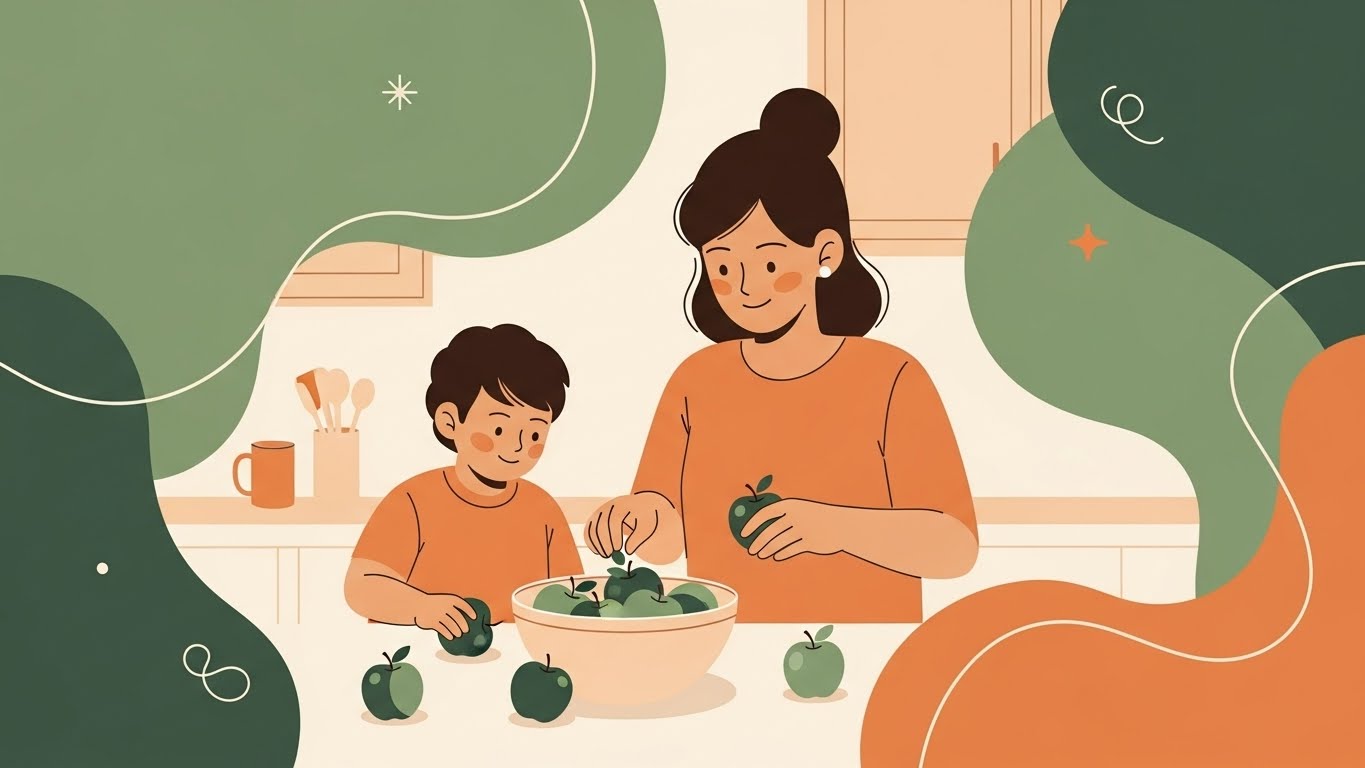
Turn snack time into a counting game: count crackers as you place them on a plate, compare who has more or fewer pieces and talk about shapes (“Your apple is a circle; mine is a crescent”). During cleanup, count how many blocks go back into the basket or how many books you read. Use words like “first,” “next” and “last” to describe sequences. Ask your child to set the table with one plate, one fork and one cup for each person, reinforcing one‑to‑one correspondence.
Sorting games and treasure hunts
Sorting and classifying objects lay the foundation for mathematical thinking. Invite your child to sort laundry by colour, buttons by size or toy animals by habitat. Create a treasure hunt around the house or yard: find three things that are soft, two things that are blue or four things that roll. These tasks develop observation, comparison and categorisation skills. Encourage your child to explain their choices, which builds reasoning.
Hands‑on science experiments
You don’t need a lab to explore science. Try sink‑or‑float experiments with household items. Mix colours using food colouring and water. Plant seeds and observe sprouting. Freeze objects in ice and see how long they take to melt. Ask your child to make predictions (“Do you think this will sink or float?”) and observe outcomes. Emphasise curiosity and discovery over right answers.
Counting in routines versus counting drills
Rather than drilling numbers, weave counting and measurement into daily life. Count steps as you climb the stairs, measure flour when baking or track the growth of a plant. Ask open‑ended questions like “What do you think will happen if we add more water?” or “How can we make this tower taller?” Allow your child to experiment, make hypotheses and observe outcomes. Celebrate mistakes as learning opportunities. Formal worksheets are not necessary; curiosity and exploration lead to deeper understanding.
References: Education Endowment Foundation – Improving mathematics in the early years; DREME/Stanford – Family Math activities[9]; NAEYC – Outdoor play benefits (including STEM learning).
Nearby nature: outdoor play—even in small spaces