Play first + academically strong
Play, projects, stories, music, art, movement, and outdoor exploration create joyful, hands-on learning while building real academic and foundational skills.


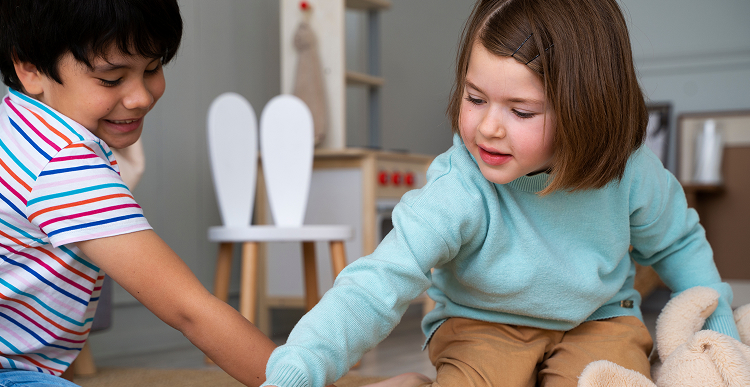
At NINI, learning begins with joyful play. Each day, our educators create engaging invitations to play, lead small-group projects, and offer multi-sensory experiences in stories, music, art, movement, and outdoor exploration. As children discover and create, our educators observe authentic moments of learning and plan next steps that keep each child growing with confidence.
Our curriculum blends the excitement of exploration with a clear academic framework built on nine domains of learning, 36 skills, and 73 sub-skills, from birth through kindergarten. Skills are mapped on a developmental continuum, so educators can see where each child is, choose the next step, and support progress through everyday play.
This approach makes learning purposeful and measurable, while still feeling natural, hands-on, and deeply engaging.

Play, projects, stories, music, art, movement, and outdoor exploration create joyful, hands-on learning while building real academic and foundational skills.
Backed by 100+ peer-reviewed studies, our structured framework clearly defines what we teach and why, ensuring meaningful and evidence-based learning.
Covers social and emotional development, approaches to learning, physical development, language and literacy, mathematics, science, social studies, creative arts, and second language acquisition.
A mapped developmental continuum guides educators in supporting each child’s growth step by step, from infancy through the kindergarten transition.
Fully aligned with the BC Early Learning Framework, U.S. state standards, and NAEYC indicators, with age-specific materials for infants, toddlers, and preschoolers.
Children explore natural and earth science and physical science by observing change, describing what they notice, experimenting with ramps and magnets, and explaining simple phenomena in words and drawings. Technology is used as a tool to investigate, record, and communicate. Children sketch results, make simple charts, and compare attempts, building early scientific habits.
Daily play grows number sense, spatial awareness, shapes, measurement, patterns, classification, and logical problem solving. Children count sets, compare sizes, compose shapes, create and extend patterns, sort by multiple features, and explain their thinking. Educators weave math talk into routines like snack counts, block building, and tidy up sorting so vocabulary sticks.
Building, testing, and improving simple structures in block and maker style projects nurture persistence and design thinking. Children plan or describe ideas before building, test, then revise, learning there are many valid solutions.
Children explore how things work using age-appropriate tools and classroom technology. Sequencing games and child-friendly devices introduce logic in concrete, playful ways.
Children draw, paint, collage, and build with a range of tools and media, experimenting with color, line, texture, and form. Open-ended studio time strengthens fine-motor control and visual discrimination and gives children authentic ways to solve problems and communicate ideas through images.
In role-play corners and story workshops, children take on characters, use props as stand-ins, and act out everyday and imaginary scenes. This symbolic play, both social and hands-on, is a key driver of development and helps children rehearse language, perspective-taking, and self-control.
Children share ideas, ask questions, and engage in back-and-forth conversations using increasingly precise vocabulary. Dramatic play, show-and-tell, and small groups create authentic reasons to speak, listen, and expand word choice.
Rhymes, syllables, and sound play tune children’s ears for reading. Brief musical games and movement-based activities keep practice lively and memorable.
Children learn letter names and sounds and understand that letters represent sounds in words. We connect letters to children’s names and classroom labels, using tactile letters and tracing trays to make learning concrete.
Children learn how books work, track print, and recognize letters, words, and spaces. Shared big book reading and environmental print highlight title pages, punctuation, and spacing in a playful way.
Storytelling, retelling, prediction, and discussion help children make sense of texts and connect stories to their lives. Puppets and prop boxes support recall, sequencing, and inference while keeping story time interactive.
Children represent ideas with marks, letters, and labelled drawings that grow into sentences and short stories. We write for real purposes such as signs, lists, cards, and class books so writing feels meaningful.
We support second language acquisition through understanding, participation, and everyday communication so children can grow in confidence in the target language. Songs, picture cues, and consistent routines build comfort, and peers model simple phrases for joining play.
Books and conversations regularly introduce number words, shapes, measurement, patterns, categories, and simple reasoning. Counting in stories and describing shapes in illustrations connect math to everyday classroom life.
Children begin to see themselves as distinct, express needs and preferences, and talk about what they like and how they feel, which supports a strong sense of self in relation to others. Educators model emotion words in stories and play so children can describe inner feelings in simple, age-appropriate language.
We coach children to identify feelings and use simple strategies to manage behavior and transitions, building the ability to adapt to change and calm their bodies. Visual cues, a quiet cozy space, and short breathing routines help children choose a strategy and rejoin activities smoothly.
Play centres and small group projects strengthen focus and the willingness to keep trying, even when tasks are challenging. Teachers chunk tasks, offer choices, and celebrate effort so children experience success and resilience.
Children practise turn taking, solving problems with peers, and forming friendships while learning to respect differences. Role play and social stories give children words for inviting others, sharing materials, and repairing after conflicts.
Songs, stories, and shared routines help children see themselves and others in the classroom community. Family photos, home language labels, and classroom jobs build belonging and everyday contribution.
Outdoor play and nature study connect learning to weather, seasons, habitats, and living things children can observe firsthand. We care for plants, keep simple observation notes, and use quiet noticing to support calm regulation and curiosity.
Children clap, sing, echo short patterns, and experiment with rhythm and pitch. Using their voices, found sounds, or simple instruments, they create rhythms and talk about how music shows feelings. We also include a wide variety of music because early childhood is a sensitive period for forming rhythmic patterns and musical understanding.
Children move with and without music, follow simple sequences, and explore personal and shared space. They create movements from their own ideas, recall short patterns, and use dance to express feelings or stories while building balance, coordination, and body control.
Running, climbing, balancing, and coordinated whole-body movement develop strength and control; children learn to hop, throw, catch, and change speed and direction with accuracy. Games emphasize safe risk-taking and spatial awareness with varied paths and obstacles that challenge new skills.
Tools, threading, clay, and art materials strengthen hand and finger control for writing and self-care. Tweezers, pegboards, lacing, and simple tools refine grip and coordination while building confidence.
Children learn to notice risks, follow simple rules, and seek help when needed in a variety of everyday situations. We role-play common scenarios and use visual reminders so safe choices become habits indoors and outdoors.
Hygiene, dressing, and feeding routines build independence and an understanding of how bodies stay well through rest, nutrition, and exercise. Step-by-step visuals and patient coaching support success, coordinated with families for consistency.
Children learn about food groups and healthy choices and help with simple food preparation when appropriate. Tasting new foods and talking about where foods come from broaden preferences in a supportive, low-pressure way.